What the research says
Why You Bite Your Nails: A Reflex, Not a Choice
Because by the time you notice, it has already happened. Nail biting is an automatic behaviour — a movement that runs without a decision being made, cued by a situation rather than by a feeling, which is why almost everyone who does it already knows they do it and already wants to stop. The most common explanation you will have heard, that it means you are anxious, is only sometimes true: one study of nail biters found around a quarter had a diagnosable anxiety disorder or OCD, with OCD itself at about 3%, no higher than in the general population. Boredom and concentration account for at least as much of it as stress does. That matters practically, because it changes what works: you cannot decide your way out of something you have not yet noticed, and the approaches with evidence behind them all begin by making the movement noticeable.
It is a behaviour, and it has a name
Nail biting is common enough to be unremarkable and persistent enough to be miserable. Up to 45% of children between roughly ten and puberty bite their nails, and the TLC Foundation for Body-Focused Repetitive Behaviors puts chronic nail biting at 20–30% of the general population, with published estimates ranging anywhere from 12% to 44% depending on how the question is asked.
Clinically it is called onychophagia, and it belongs to a group of behaviours — hair pulling, skin picking, cheek biting — collectively called body-focused repetitive behaviours. DSM-5 files them under "Other Specified Obsessive-Compulsive and Related Disorders," which is the source of a great deal of confusion, and which we will come back to, because the filing is not the diagnosis most people assume it to be.
What makes something a BFRB rather than a habit is not the behaviour itself but its consequences: repeated attempts to stop that do not succeed, and real distress or damage. Somebody who chews a nail occasionally when a film gets tense is not in this category. Somebody who has tried to stop four times, who hides their hands, and who has torn skin at the sides of the nails is.
The anxiety story is mostly wrong
Almost everyone who bites their nails has been told at some point that it means they are anxious. It is worth knowing that the research does not support this as a general explanation.
A study of nail biters found that only about 25% had a comorbid anxiety disorder or OCD. OCD specifically ran at around 3.1% — which is roughly its prevalence in the general population, meaning nail biting on its own says close to nothing about whether somebody has it. The DSM-5 filing under obsessive-compulsive and related disorders describes a family resemblance in how these behaviours work, not a claim that everyone who does them has OCD.
Stress is real and it does drive biting for plenty of people. But framing the behaviour as an anxiety symptom does two unhelpful things. It sends people looking for an emotional cause that may not be there, and it makes the behaviour feel like a verdict on their mental health rather than a motor habit that got established and stayed. Plenty of nail biters are not especially anxious people. They are people whose hands learned a movement.
None of this rules anything out for any individual. If the biting comes with rising tension beforehand and relief afterwards, is hard to stop even once noticed, or continues past pain, that is a pattern worth taking to a doctor or a therapist — and a cosmetic product is not the answer to it.
What actually triggers it: the situation, not the feeling
The most useful finding in this literature is unglamorous. When researchers tracked when students actually bit their nails, the behaviour clustered around being alone — the highest frequency by a wide margin — and around academic demand. It fell sharply during social interaction, and fell further when somebody visibly disapproved.
Read that again as a description of a trigger, because it is not describing an emotion. It is describing a situation: unobserved, and occupied. Alone at a desk. Alone in a car. Alone in front of a screen at eleven at night. The hand comes up because nothing is watching and something else has your attention.
This is why "I bite when I am stressed" and "I bite when I am bored" are both true and not in conflict. Understimulation and overstimulation produce the same movement, because the movement is not about the feeling at all — it is a piece of self-regulation that runs in the background whenever attention is elsewhere. The biting is what the hands do when nobody, including you, is paying attention to them.
Why deciding to stop does not work
Here is the mechanical problem, and it is the whole reason willpower has such a poor record against this.
A conscious decision is available at the moment you notice something. An automatic behaviour, by definition, has already begun before that moment arrives. By the time the thought "I am biting my nails again" is available to you, the hand is at the mouth and a nail is already shorter. You are not deciding whether to bite; you are reacting to having bitten. Resolve applies to the wrong end of the sequence.
That is also why the familiar advice is so useless in practice. "Just stop" asks for a decision at a moment when no decision is on offer. "Keep your nails short" removes the surface but not the movement, and people bite skin instead. Sitting on your hands works while you remember, which is to say while you are watching, which is exactly the condition under which you were not going to bite anyway.
What all the approaches that do work have in common is that they attack the noticing rather than the deciding. They move the moment of awareness earlier, from after the bite to during or before it, and only then does a choice actually exist.
What has evidence behind it
Three approaches, in descending order of how much published support they carry.
| Approach | What is known about it |
|---|---|
| Habit reversal training | The best-supported approach by some distance, and it is a behavioural method rather than a product. It has three parts: learning to catch the movement early, substituting a competing action the hand cannot do at the same time as biting, and arranging some support around it. In trials, nail length after treatment was around 12.1 mm against 8.8 mm for placebo, and one study reported a 99% reduction in biting episodes against 60% for a comparison technique. A therapist trained in it is the fastest route; the method is also documented well enough to be worked through independently. |
| A bitter deterrent | Supplies the noticing, immediately and without you having to remember anything. The taste arrives the instant a nail reaches the mouth, which moves the moment of awareness to exactly where it needs to be. That is a narrow job, and it is a real one — most people cannot catch an automatic movement by intending to. It does not address why the habit exists, so it works best on ordinary absent-minded biting and works poorly when something else is driving it. |
| Medication | Limited evidence and not a first step. N-acetylcysteine showed modest improvement at one month in one study; tricyclic antidepressants showed efficacy but with a 44% dropout rate, which tells you what taking them for this is like. Mentioned here only because "nail biting medicine" is a common search, and the honest answer is that there is no established drug treatment for nail biting. |
Combining the first two is the sensible default for most adults: the deterrent provides the awareness that habit reversal needs in order to have something to work on.
What it is costing, which is the reason to bother
Most people who bite their nails frame it as a cosmetic problem and a source of embarrassment. Those are real, and there are two less obvious costs worth knowing about, neither of which is a scare tactic.
The first is dental. Habitual nail biting is associated with wear on the incisors, with malocclusion, with apical root resorption, and with temporomandibular joint dysfunction. These are the documented consequences of using front teeth for something they were not designed for, several thousand times.
The second is infection. Acute paronychia — the painful, swollen infection at the side of a nail — typically comes from inoculating bacteria from the mouth into broken skin on the finger, which is precisely what biting does. It is the most common complication and the one most likely to send somebody to a doctor.
Neither of these is a reason to panic, and neither is a reason to feel worse about a behaviour that already carries plenty of shame. They are the reason it is worth putting real effort into rather than resolving again in January.
Where to start this week
Four things, in this order, none of which require deciding to stop.
Find out when you actually do it
For three days, note the situation each time you catch yourself — not the emotion, the situation. Alone at a desk, in the car, watching something, on the phone. Most people find two or three settings account for nearly all of it, and the pattern is usually more specific and more boring than they expected. You cannot intervene on a habit you have not located.
Make the movement noticeable
This is the step the research keeps pointing at. A bitter polish does it chemically and without effort on your part, which is why it is the common starting point; a well-placed reminder or a physical marker on the hand can do it too, though both rely on you remembering to set them up. The goal is not to stop the hand. It is to know that the hand has moved.
Give the hand something else to do in those situations
A competing response is the core of habit reversal: something the hand cannot do while also biting, held for a minute or so when the urge arrives. A clenched fist, a hand flat on a leg, an object to hold. It sounds trivial and it is the part with the strongest evidence behind it.
Repair the nails at the same time, and be patient about it
Visible improvement is what sustains people through the hard fortnight, and bitten nails take a while to look normal — a nail takes about six months to grow out completely, so the hands will lag well behind the habit. Running a hardener or a nourishing cream alongside gives you something to see in the meantime.
What MAVALA makes, and what it does not do
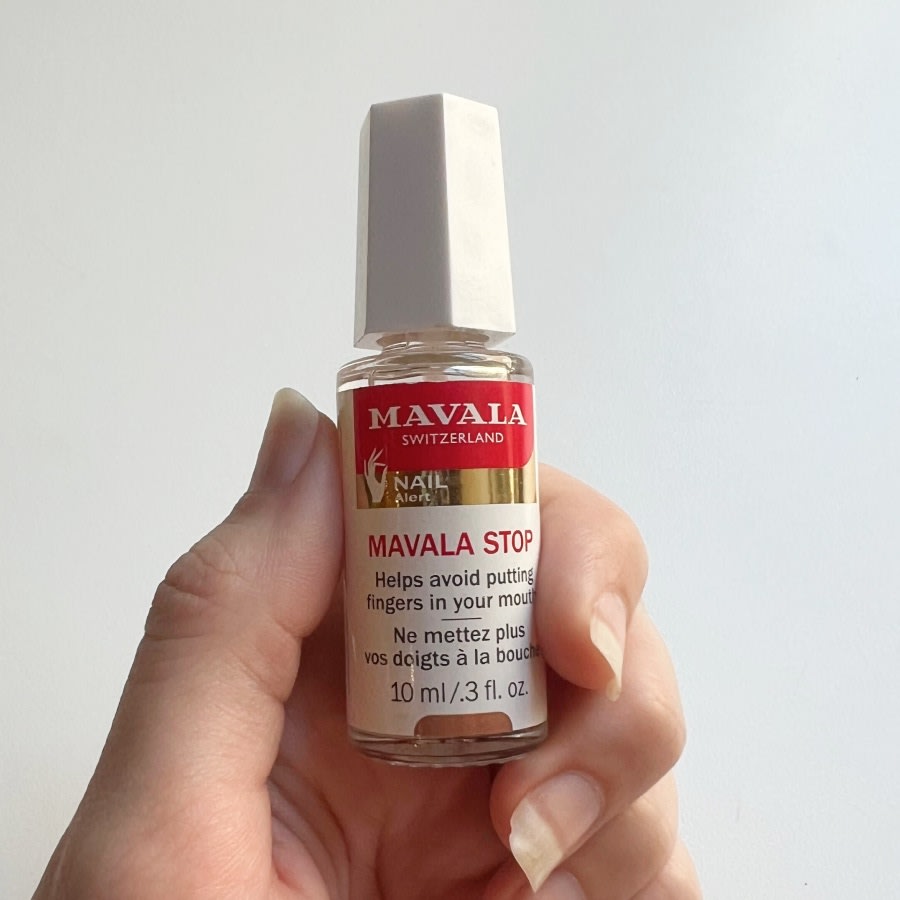
- Mavala Stop bitter nail polish
A clear lacquer with a bitter taste, applied every second day. Its entire role in the above is the second step: it makes the movement noticeable at the moment it happens. It is a cosmetic product, not a medicine, it does not treat a condition, and it does not address why the habit exists. Dries clear and without a shine, wearable over coloured polish, suitable from age 3, free from formaldehyde, phthalates, SLS, parabens and fragrance.
- Mavala Stop Pen
The same formula in a pen. Easier to carry, and easier to use on the skin at the side of the nail — which matters if you pick as well as bite.
- the 33-day plan
This page is the why. That one is the how: the full protocol week by week, what to expect, and what to do about a relapse.
- do bitter nail polishes actually work?
The honest evaluation, including the four things worth judging one on and the situations where it is the wrong tool.
- nail biting in children, by age
If the person biting is a child, the decision is a different one. What is normal at each age, why the floor is 3, and how to raise it without it becoming a punishment.
What to use
What we make, and the narrow job it does in all of this.


The questions behind the question
Because it is an automatic behaviour rather than a decision. The movement is cued by a situation — most often being alone and mentally occupied — and it begins before you are aware of it, which is why you usually notice only after a nail is already shorter. Research tracking when people actually bite found the highest frequency when subjects were alone, and a sharp drop during social interaction. Boredom and concentration account for at least as much of it as stress does, and for many people it is simply a motor habit that became established and stayed.
Usually not, despite how often it is said. One study of nail biters found only around 25% had a comorbid anxiety disorder or OCD, and OCD specifically ran at about 3.1% — roughly its rate in the general population, meaning nail biting on its own tells you very little. DSM-5 does file it under "Other Specified Obsessive-Compulsive and Related Disorders" as a body-focused repetitive behaviour, but that describes how the behaviour works rather than diagnosing anyone who does it. Stress genuinely does drive biting for some people; it is not the general explanation.
Very. Up to 45% of children between roughly ten and puberty bite their nails, and the TLC Foundation for Body-Focused Repetitive Behaviors estimates that 20–30% of the general population bites chronically, with published estimates ranging from 12% to 44% depending on how the question is asked. It declines with age but plenty of adults never stop, and some begin in adulthood.
Because a decision is only available at the moment you notice something, and an automatic behaviour has already started before that moment arrives. By the time you think "I am doing it again", the nail is already shorter — you are reacting to having bitten, not choosing whether to. That is why "just stop" fails, why keeping nails short often moves the biting to the skin instead, and why every approach with evidence behind it starts by making the movement noticeable earlier rather than by asking for more resolve.
Habit reversal training has the strongest evidence by a wide margin: catching the movement early, substituting a competing action the hand cannot perform while biting, and arranging support around it. In trials, post-treatment nail length was around 12.1 mm against 8.8 mm for placebo, and one study reported a 99% reduction in episodes against 60% for a comparison technique. A bitter deterrent does a narrower job well — it supplies the noticing automatically, which is the part most people cannot do by intending to. There is no established drug treatment. Combining the behavioural method with a deterrent is the sensible default for most adults.
Beyond the appearance, there are two documented costs. Dental: habitual biting is associated with incisor wear, malocclusion, apical root resorption and temporomandibular joint dysfunction. Infection: acute paronychia, the painful swelling at the side of a nail, typically comes from inoculating mouth bacteria into broken skin on the finger, and it is the most common complication. Neither is a reason to panic, and both are reasons to treat it as worth real effort rather than another resolution.
There is no established drug treatment. N-acetylcysteine showed modest improvement at one month in one study, and tricyclic antidepressants showed efficacy in trials but with a 44% dropout rate. That is the whole of the evidence base, and it is why the behavioural approaches and a deterrent are where the practical answers are. A bitter nail polish is a cosmetic product, not a medication, and it makes no medical claim.
When it is hard to stop even after you notice it, when it continues past pain, when it follows a build-up of tension that the biting relieves, when it causes repeated infections, or when it is causing real distress or social avoidance. That pattern is what distinguishes a body-focused repetitive behaviour from a habit, and the treatments for it are behavioural rather than cosmetic. A doctor, or a therapist trained in habit reversal, is the right starting point — a nail product is not.
MAVALA CARES
We care about the planet. We aim to minimise our impact on the environment through the following measures:
Ingredients
We source our ingredients and raw materials from the nearest suppliers in Switzerland to reduce our carbon footprint. We also increasingly use ingredients that are readily biodegradable. In particular, we do not use plastic microbeads nor cyclopentasiloxane (D5), which contribute to ocean pollution.
Packaging
Whenever possible, we package our products without a box or cellophane and in recycled and recyclable materials (including plastic and glass) to reduce waste. We have also implemented clear labelling on product packaging to assist you in knowing which part of the packaging can be recycled and how.
Manufacturing
Whenever possible, we manufacture under cold conditions to reduce energy consumption. We are also implementing strict waste separation and recycling processes in our production site and warehouses, including that of our Canadian distributor.


