After a summer of colour
Why Nails Go Yellow Under Polish — and What Actually Whitens Them
Because the coloured pigment in nail polish soaks into the top layers of the nail plate, and keratin holds onto it. It is a stain, not dirt and not damage, which is why scrubbing does nothing and why it is almost always harmless. The part nobody says out loud: no cosmetic product dissolves that pigment back out — not ours, not anyone’s. A whitener works optically, by cancelling the yellow you can see, and the stain itself leaves the only way it can, by growing off the end of your finger over about six months. What you can do immediately is make the yellow invisible, stop the next manicure from adding to it, and rule out the one version of yellow that is not a stain at all.
What the yellow actually is
Nail polish is pigment suspended in a film. When that film sits directly on the nail for a week or two, some of the pigment migrates into the surface layers of the nail plate and stays there. The nail plate is keratin — porous, layered, and perfectly capable of holding a dye, which is the same reason hair takes colour.
Certain pigments do far more of this than others. The reds and the deep oranges are the usual culprits, along with anything dark enough to need a heavy pigment load. A summer of coral and red, then, is close to the worst case, and the stain does not announce itself until the polish comes off, which is why this looks like it happened overnight.
It is also worse on a nail whose surface is not smooth. Pigment concentrates in cracks, pits and the fine scratches left by filing or buffing the top of the plate, so a nail that has been buffed shiny before polish will usually stain more than one that has not. That detail matters later, because the most common home remedy for this problem is to buff it off.
What it is not: dirt, a sign that your nails cannot breathe, or damage in any structural sense. The nail is not weaker for being stained. It looks bad and it is harmless, and those two facts are the whole of it for the large majority of people reading this.
The chalky white version, which is a different thing
Sometimes what appears after the polish comes off is not yellow but white — dry, chalky patches, often rough to the touch, usually towards the tip. This is keratin granulation, and it gets mistaken for both yellow staining and for fungus, which is unfortunate because it is the least serious of the three.
It comes from the surface of the nail plate being dehydrated: polish worn for a long stretch without a break, acetone remover, or both. The top cell layers dry out and lift slightly, and light scatters off them instead of passing through, so they read as white and powdery rather than translucent.
The fix is uninteresting and reliable. Leave the polish off for a few weeks, keep the nail and the skin around it oiled, and let the affected layers grow off. Do not sand them flat — that removes healthy plate along with the damaged surface and sets up the next round. If you are going back into polish before the nail has recovered, a base coat made for dry nails is the right one to use.
Chalky white patches that thicken the nail, crumble at the edge, smell, or spread from one nail to the next are not this, and are worth a doctor’s look rather than a base coat.
When yellow is not a stain
This is the part a nail care company should be quickest to say, because the failure mode is somebody spending three months whitening an infection.
See a professional
The nail is thickening, crumbling or lifting
Discolouration that comes with a thickened plate, a crumbly free edge, debris underneath, or a nail separating from its bed is not polish stain. Fungal infection is the common cause and it does not respond to anything cosmetic. A doctor or a pharmacist can tell you in a few minutes what you are looking at, and confirming it early is the difference between a short treatment and a long one.
See a professional
Several nails yellowed with no polish involved
Yellowing across nails that have not been polished, especially if it arrives with changes in the shape or curvature of the nail, belongs to a doctor rather than to a manicure. There is a short list of medical causes, some of them ordinary, and none of them are for us to diagnose from a web page.
Usually just a stain
One or two nails, yellow only where the polish sat
Even discolouration confined to the polished surface, appearing after a dark or red shade, on a nail that is otherwise normal in thickness, shape and attachment — that is the ordinary case, and the rest of this page is about it.
Nicotine stains the nail plate the same way pigment does, from the outside in, and looks identical. If that is the source, the nail will keep re-staining as it grows, and no manicure step changes that.
What actually works, and what only appears to
Ranked by whether the thing is doing what people think it is doing.
| What people try | What it really does |
|---|---|
| An optical whitener | Works, and works immediately — but optically. An optical azurant shifts how the nail reflects light so the yellow stops reading as yellow, the same principle as the brightener in laundry detergent. It is a correction you can see the day you apply it. It is not dissolving the pigment, and it does not shorten the grow-out. |
| Time | The only thing that removes the stain, because the stained keratin has to leave the finger. A fingernail replaces itself completely in about six months, so a stain in the middle of the plate is roughly a season from gone. Unsatisfying, and true. |
| A white pencil under the tip | Works for what it is for, which is the underside of the free edge, not the nail plate. It brightens the white line at the end of the nail and makes the whole hand read as cleaner. It cannot touch a stain sitting in the surface of the plate, and buying it for that will disappoint you. |
| Buffing it off | Removes the stain and some of your nail with it, then leaves a roughened surface that takes up pigment faster next time. It is the one remedy on this list that makes the underlying problem worse. If the surface is uneven, a ridge filler under the polish is the answer rather than the file. |
| Lemon juice, baking soda, whitening toothpaste | Mild acid and mild abrasive. Some people see a difference on light surface staining, which is the abrasive doing a gentler version of buffing. On real pigment staining they do very little, and repeated scrubbing costs you the smooth surface that was protecting the nail. |
| Hydrogen peroxide or household bleach | Do not. These turn up in listicles constantly. They dry and weaken the nail plate and irritate the skin around it, and the nail you get back is a paler, more brittle, more absorbent nail that stains again sooner. |
The two-week reset
What to do the fortnight after a summer of colour, in the order that matters.
Take the polish off and leave it off for a bit
Nothing on this list works while the nail is covered. A fortnight bare is enough for a dehydrated surface to recover and for you to see what you are actually dealing with, which you cannot do under three coats. Use an acetone-free remover to get there if you have the choice.
Look properly, once, in daylight
Thickness, the free edge, whether the nail is attached along its whole bed, whether unpolished nails are affected too. Thirty seconds, and it either sends you to the rest of this list or to a doctor. Do not skip it because the answer is probably reassuring.
Oil the nail and the skin around it, nightly
The surface layers stain more and look worse when they are dry, and the cuticle takes the brunt of a season of remover. This does not lift the stain. It changes how the nail looks under light, and it is the step that makes the recovering surface stop reading as chalky.
Cover the yellow while it grows out
An optical whitener over bare nails is the immediate cosmetic answer, and it can go under a pale polish so a nude or pastel shade is not thrown off by the yellow underneath. For a bare-nail look, the white pencil under the free edge does most of the work of a French manicure in about a minute.
Never put a coloured polish straight onto the nail again
This is the only step that changes next season. A base coat is a barrier between pigment and keratin, and it is the difference between a stain and no stain. It is also the step most often skipped, because it is invisible and it feels like it is costing you five minutes for nothing.
Preventing the next one
Everything above is damage control. The prevention is one habit and it is not a difficult one: a base coat, every time, under every colour, with no exception for the shade you are only wearing for a weekend. The pigment does not know how long you intended to keep it on.
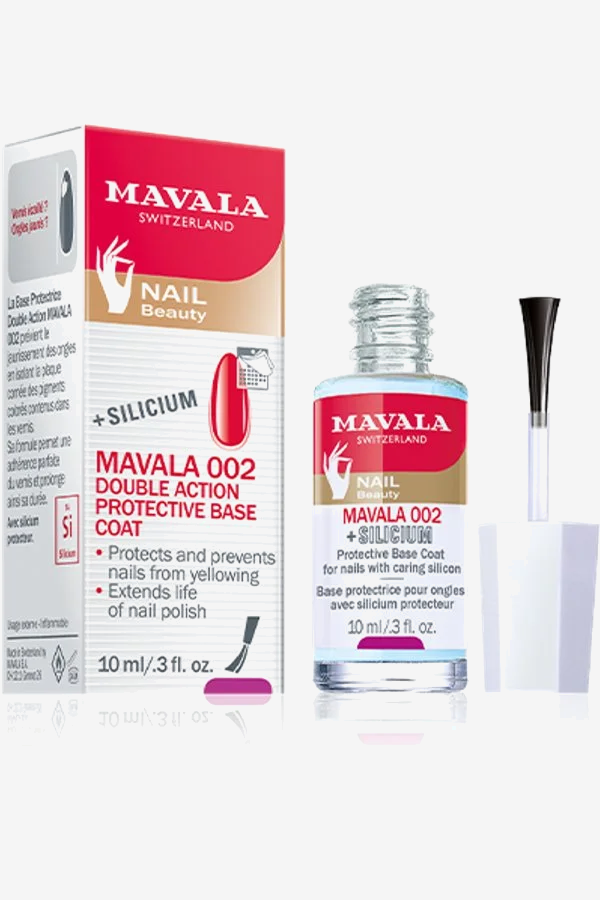
Which base coat depends on the nail rather than on the polish. If your nails are in reasonable condition and the problem is purely staining and a manicure that chips by day four, a protective base coat is the straightforward choice. If they are dry, splitting or brittle after a summer of remover, a base made for dry nails does the same barrier job while treating the reason the surface is rough in the first place — and a rough surface is what let the pigment in.
Two smaller habits help more than they should. Give the nail a few days bare between manicures rather than refreshing the colour on top of the old one, which is where a fortnight of wear quietly becomes six weeks. And use an acetone-free remover where you can; acetone strips the surface, and a stripped surface is an absorbent one.
What MAVALA makes, and which problem each one solves
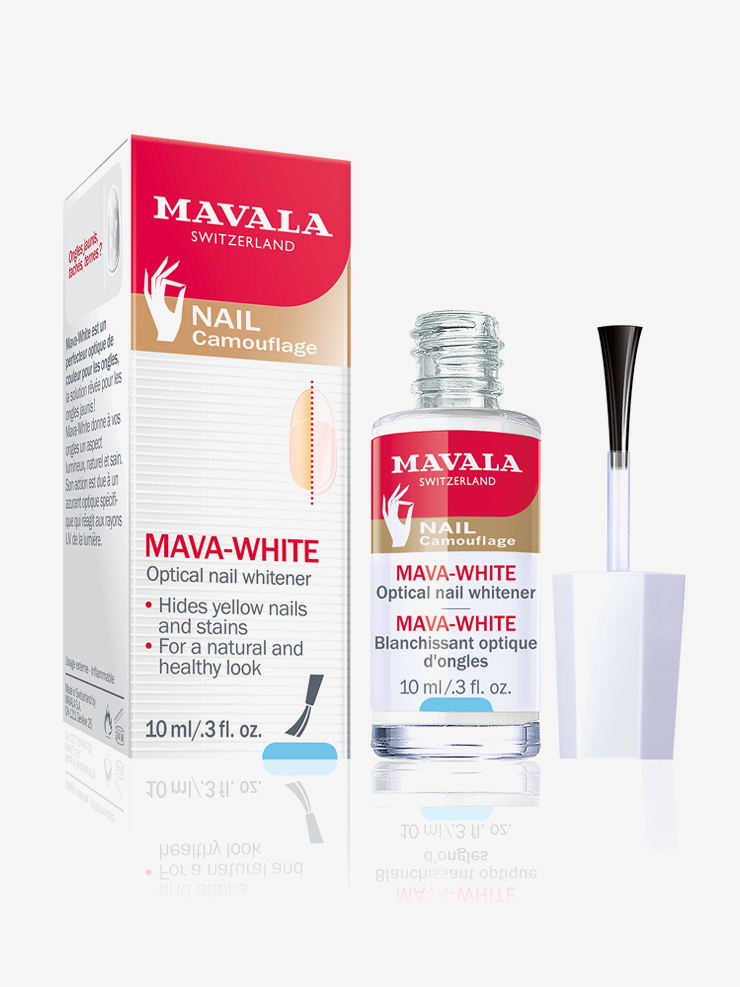
- MAVA-WHITE optical nail whitener
An optical azurant that counteracts yellowing and dullness on the nail plate. Three ways to use it: alone on bare nails for a matt finish, between a base coat and a top coat for longer hold and shine, or under a pale polish so the colour is not distorted by the yellow beneath it. It corrects how the nail reads; it does not remove the pigment, and no cosmetic does. Free from formaldehyde, phthalates, SLS, parabens and fragrance.
- MAVALA 002 protective base coat
The prevention. Its formula prevents the pigments in nail polish from coming into direct contact with the nail plate, which is what protects it from yellowing, and its deliberately tacky finish grips the colour so the manicure lasts longer. Contains organic silicon for flexibility and resistance. If you only change one thing after reading this page, change this one.
- HYDRA-BASE COAT
The same barrier against polish pigments, for nails that are dry, brittle or devitalised — which after a summer of remover is most of them. Water-based, with pro-vitamin B5, silk amino acids and keratin components. It cannot be worn on its own; it goes under polish or a top coat.
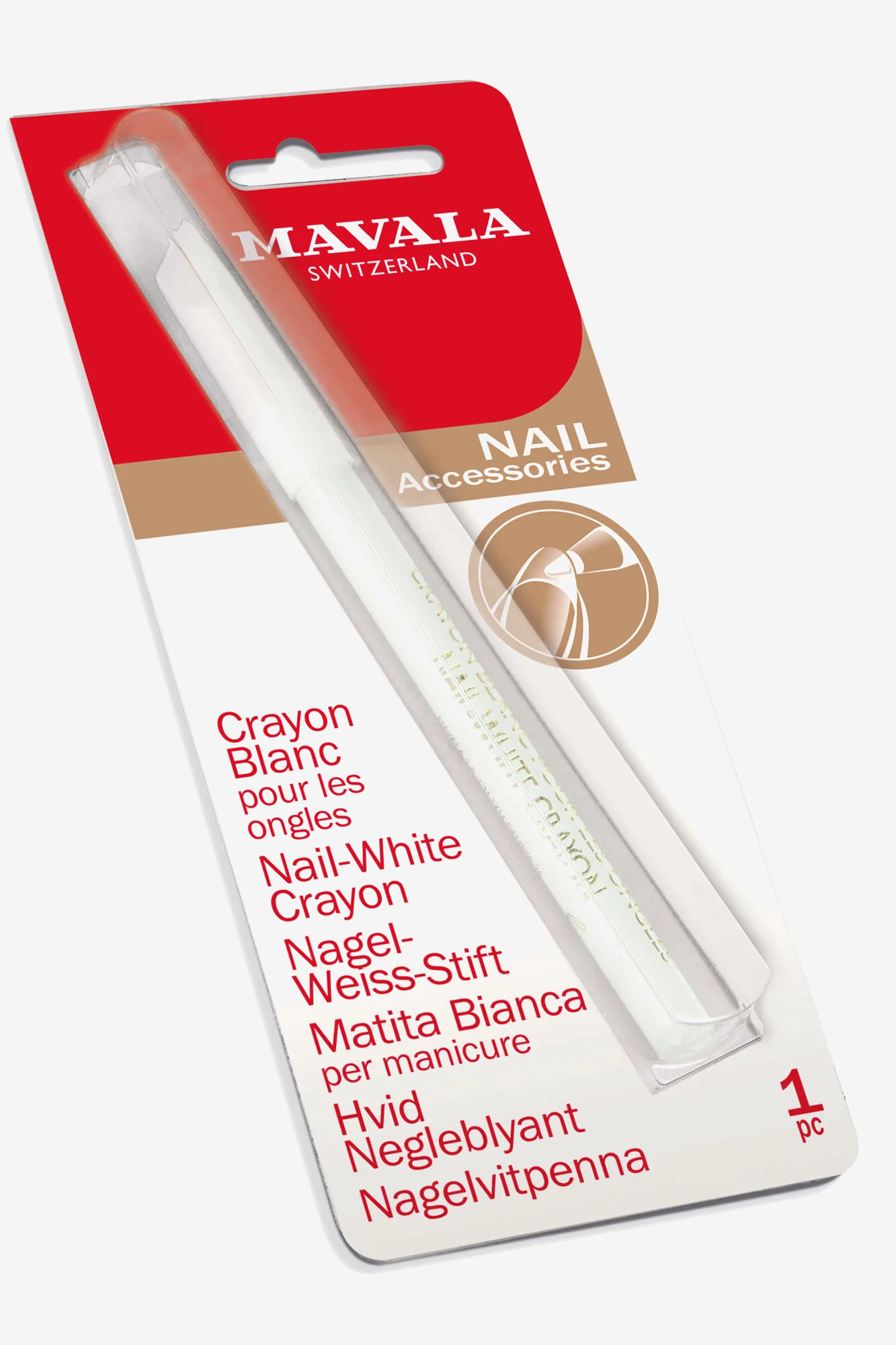
- NAIL WHITE CRAYON
For the underside of the free edge, not the nail plate. Moisten the tip, run it under the ends of the nails, and the tips read white and clean — a French manicure without polish, in about a minute. It is the product most often bought for stain removal and it is not that; it is the fastest way to look tidy while the stain grows out.
- RIDGE FILLER
If the surface is uneven and you were about to reach for a buffer, use this instead. It smooths the nail optically under polish without taking any of the plate away, which keeps the surface that stained from becoming the surface that stains faster.
- the 12-week plan for weak, splitting and peeling nails
If the nails under the stain are also soft, splitting or peeling after a season of colour, the discolouration is the smaller of the two problems. This is the routine for the other one.
What to use
Three products people confuse with one another, described by what each one actually does.
The questions behind the question
Because coloured pigment from the polish has soaked into the top layers of the nail plate. The nail is keratin, which is porous and holds a dye much as hair does, so the colour stays behind after the polish is removed. Reds, deep oranges and dark shades do it most, and a nail whose surface has been filed or buffed takes up more pigment because the pigment concentrates in the fine scratches. It is a stain rather than damage, and the nail is no weaker for it.
Two things at once: cover the yellow now, and let the stain leave on its own. No cosmetic product dissolves pigment back out of keratin, so the stain itself goes only as the stained nail grows off the end of the finger, which takes about six months for a full fingernail. In the meantime an optical whitener cancels the yellow visually from the day you apply it, and a white pencil under the free edge makes the tips read clean. Avoid buffing it off — that removes nail and leaves a rougher surface that stains faster next time.
No, and it is worth being precise about it. An optical nail whitener such as MAVA-WHITE contains an optical azurant, which changes the way the nail reflects light so that the yellow no longer reads as yellow — the same principle as the brightener in laundry detergent. The effect is immediate and entirely visual. The pigment is still in the keratin and still has to grow out. Any product claiming to lift a polish stain out of the nail is claiming something a cosmetic cannot do.
A fingernail replaces itself completely in about six months, so a stain that reaches the base of the nail is roughly that long from gone, and one already halfway up the plate is nearer three months. The improvement is gradual rather than sudden: the stained band moves towards the tip and gets trimmed away a little at a time. Nothing shortens this, which is why the useful work in the meantime is cosmetic cover and prevention rather than removal.
Usually keratin granulation: the surface layers of the nail plate dried out by a long stretch of polish, by acetone remover, or by both, so that they lift slightly and scatter light instead of passing it through. It looks powdery and feels rough, and it is the least serious of the things mistaken for it. Leave the nails bare for a few weeks, oil them nightly, and let the affected layers grow off — do not sand them flat, which removes healthy nail as well. Patches that thicken the nail, crumble, smell or spread between nails are a different matter and should be seen by a doctor.
A polish stain is confined to the surface that was polished, appears after a dark or strongly pigmented shade, and leaves the nail normal in thickness, shape and attachment. Suspect something else when the nail is thickening or crumbling, when there is debris under it, when it is lifting away from the nail bed, when unpolished nails are discoloured too, or when it spreads from one nail to another. That belongs to a doctor or a pharmacist rather than a manicure — nothing cosmetic treats a nail infection, and time spent whitening one is time lost.
Yes, and it is the only step that changes the outcome rather than the appearance. A protective base coat sits between the pigment and the keratin so the colour never touches the nail plate — MAVALA 002 is built around exactly that, and Hydra-Base Coat does the same barrier job on nails that are dry or brittle. Use one under every colour, including the shade you only mean to wear for a weekend, because the pigment does not know how long you intended to keep it on.
They treat two different surfaces and are frequently bought for the wrong one. A nail white crayon is moistened and drawn under the free edge, so it whitens the underside of the tip — a French manicure look in about a minute, and nothing to do with the nail plate. An optical whitener is applied on top of the nail plate and corrects how the whole nail reads under light, which is what you want for yellowing from polish, nicotine or dullness. If the stain is in the surface of the nail, the pencil will not help; if you only want brighter tips, the whitener is more than you need.
You can, and it is the one remedy that makes the next stain worse. Buffing removes the stained surface along with healthy nail plate, thinning it, and it leaves behind a roughened surface with more of the fine scratches that pigment concentrates in — so the nail restains faster and more deeply than before. If the reason you want to buff is an uneven surface rather than the colour, a ridge filler smooths it optically under polish without taking anything away.
MAVALA CARES
We care about the planet. We aim to minimise our impact on the environment through the following measures:
Ingredients
We source our ingredients and raw materials from the nearest suppliers in Switzerland to reduce our carbon footprint. We also increasingly use ingredients that are readily biodegradable. In particular, we do not use plastic microbeads nor cyclopentasiloxane (D5), which contribute to ocean pollution.
Packaging
Whenever possible, we package our products without a box or cellophane and in recycled and recyclable materials (including plastic and glass) to reduce waste. We have also implemented clear labelling on product packaging to assist you in knowing which part of the packaging can be recycled and how.
Manufacturing
Whenever possible, we manufacture under cold conditions to reduce energy consumption. We are also implementing strict waste separation and recycling processes in our production site and warehouses, including that of our Canadian distributor.